
by Mark Tuttle, 10th
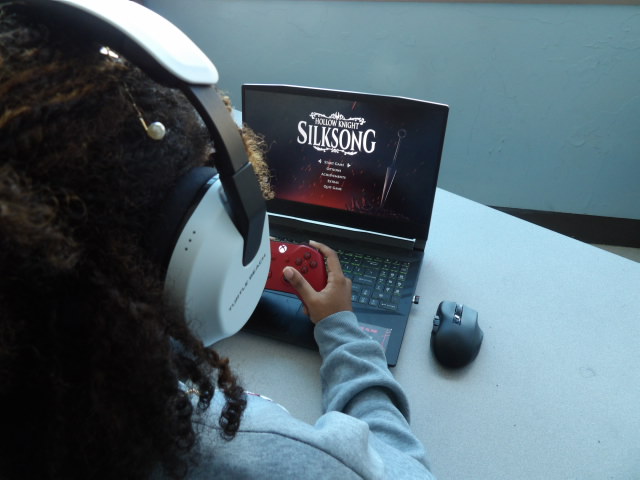
Hollow Knight: Silksong, or Silksong for simplicity, is the successor to the game Hollow Knight, a beloved Metroidvania indie game that was developed by Team Cherry and released in February of 2017. While it was initially somewhat of a disappointment, its console ports and strong word of mouth helped it grow! This eventually led to the announcement of Silksong. However, Silksong would not be released for 8 years, with little to no news released in the meantime.
Before discussing the game itself, it’s important to first explain what a Metroidvania even is. Metroidvanias are a sub-genre of 2D platformer games. Where it differs is that Metroidvanias, rather than emphasizing pure platforming, are more defined by how the world is mostly inaccessible at the start, so as the player unlocks more abilities and knowledge, they backtrack to previously locked areas and discover hidden secrets. Silksong is no different—at least, not at its absolute core.
Now, Silksong is fairly easy to pick up as the game eases players into its mechanics and its controls quite well. However, it could do a better job at explaining how attacking works—it doesn’t notify players about up and down attacks—but that’s a minor detail that only affects the user if they’ve never played anything like Silksong, or video games in general. I’m not the only one who experienced these challenges, evident by this quote from Mr. Joe Wagner—my stepdad—, “The journey is, however, not without its difficulties. I found myself wishing that boss encounters were a bit easier; and, being brand new to 2D platformers, I found myself struggling with basic movement mechanics such as pogoing and down diagonal attacks.” While the more experienced, Mx. Tai Lee—a close friend—said, “Some of the struggles I’ve noticed are the sparse amount of rest stops, such as benches. Some of the areas only have one, which makes dying much more punishing because it takes a while to get back. I’d add maybe one more bench in each area, just so it’s less frustrating to get back.”
Lee and Wagner’s reviews show that even more adept players still struggle. While the game is simple to grasp, it certainly isn’t easy by any measure. Silksong is a hard game, harder than its predecessor, which means the difficulty is part of the experience. The player is meant to master the techniques prevalent in the game, like using the down attack to bounce off of enemies and reach platforms that were inaccessible through normal platforming. The bosses have recognizable patterns that you can learn quickly, but with the lack of a boss bar it’s impossible to gauge how far you are in a fight save for the bosses going into a second phase. Another thing that can be troublesome is the lack of invulnerability when binding—a mechanic in the game which heals the player by using silk collected by doing damage—since every hit takes off one of the player’s hitpoints and getting silk to bind with so you can restore those health points requires them to risk health. It can be really aggravating sometimes to die while healing because some random bug ran into you.
And even with the listed flaws, the opinions of Mx. Lee are certainly much more favorable, “What makes this game worth playing is not only the insanely cheap price, but the love and care that’s put into every detail of the game. Team Cherry is a small indie team, and you should always support small devs when you can,” along with Mr. Wagner’s review containing similar praise: “There’s a lot to like about this game. It is visually appealing; the high difficulty means players can enjoy a sense of accomplishment as they defeat tricky bosses and ascend the learning curve; and exploration is rewarding and fun.” The game is certainly more than worth its low price and high challenge.
All in all, Hollow Knight: Silksong is a phenomenal game and the good definitely outweighs the bad. If anything in this review sounds enticing, then checking out the game is a must. It’s cheap, engaging, and beautifully made.
Credits to my friend Tai-Lee for buying me the game and credits to them and my step-dad for being interviewed.