
Pro: Yes
by Mark Tuttle, 10th
Personal Computers (PCs) have been around since 1971 but haven’t been in school spaces for the most part until more recently. The question is: should students be allowed to bring a PC as opposed to the school issued chromebook?
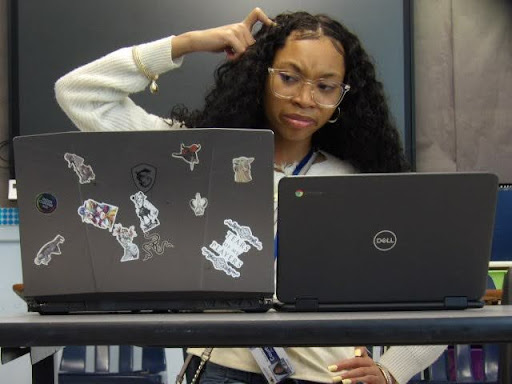
First, personal computers are just that—personal. A big factor in this conversation is that the student has full creative control over how their personal laptop may look and function such as any custom shortcuts or settings they have that might be blocked on chromebooks or even just using a different browser that they prefer as opposed to google. In addition, many students prefer their own device over a school-assigned chromebook that could be broken on receipt. Any of the above are viable reasons for a student to use their personal laptop. Second, the restrictions of the wi-fi on students and others attempting to use it are selective and sometimes truly hindering. JPSD Wi-Fi and JPSD Guest block a multitude of websites no matter what device. This is something that is avoidable on a personal computer as students have the freedom to install a VPN, or virtual private network. This allows students to access many official websites that would otherwise be blocked, such as the JPSD website and our own news site, neither of which are accessible without a VPN. Lastly, the chromebook shortage. At Murrah, there is an obvious shortage of school chromebooks as not every student has one. This leads to students being unable to do some of their work unless provided a chromebook by another student or teacher, which is a problem since the aforementioned shortage means that many teachers don’t have chromebooks to give their students. This can be at the very least alleviated by allowing students to bring their personal computers to school.
While school computers get the job done, personal computers can do that and a lot more as there is a multitude of evidence for papers and information that could be used which is blocked by the school-issued chromebooks. It’s not necessary for chromebooks to be done away with but the option to be able to opt out and use your own computer is certainly doable.
Taking a look outside of Murrah, it’s plain to see that this isn’t limited to the walls of this school. From EBSCO Industries Inc. in an article written by Joy Crelin—a freelance writer and editor—they mention the BYOD Policy or Bring Your Own Device which has been implemented in many schools across the nation due to budgeting issues contributing to a lack of school-issued computers. This policy asks students to bring their own devices to do their school work. These schools are examples of schools encouraging students to bring their personal computers to school. So what’s the takeaway? If other schools are allowing PC’s to be brought to school, why not Murrah? Personal computers aren’t a problem, so why not allow students to bring them.
Con: No
by Courtney Brown, 10th
Computers are becoming an essential item in schools, much to plenty of people’s dismay. But, due to how much technology has advanced over the past few decades, online assignments have increased to the point of it being mandatory to acquire a computer. Due to them being a popular staple in today’s day and age, schools have started to issue computers for students. Due to some schools not being able to obtain computers for all students, and other outside factors, there has been a debate on whether or not students should be able to bring their own computers to school. Yes, students having laptops or computers of their own has its pros, but so does it have its cons.
Of course, there will be distractions when a student has their own computer instead of a school issued one. Students could search up inappropriate or irrelevant things during instructional time which could lead to plenty of distractions that would cause students to focus on things that are not related to class or their assignments. Security issues are also a very big consideration when talking about personal computers. Personal computers are more likely to have viruses as opposed to school mandated ones because school computers have sensors that filter both inappropriate media and viruses.
On the contrary, personal computers allow media that could leak onto the school network, introducing security threats to the entire system. Students could also have trouble with accessing certain websites or apps needed for assignments, creating inconsistencies for the work environment. Lastly, the meat of this discourse is the lack of trust. Students would have way more freedom to roam any and whatever websites they want with a personal computer due to the limited restrictions. Schools would have less control over what students are doing while taking important tests or completing significant assignments. I mean, most students with school issued computers often find a way to cheat on exams. So, what would stop them from cheating on their personal computer?
As JPS does prohibit use of personal devices (such as phones, headphones, and tablet devices, etc.), personal computers can be used for productive purposes such as schoolwork or instructional websites for schools. As these cases are common when using these devices, they are not completely encouraged or trusted during instructional time and school issued lap-tops are mandatory for students during exams. Security issues—such as the specific, specialized, and secure websites that are an essential part of testing and inaccessible on personal computers—leave schools no other choice but to bestow school-issued computers upon their students.
Yes, having a personal computer isn’t a problem as long as there are restrictions being enforced on them. But, let’s be real, not all personal computers can be monitored by teachers or the administration at all times. So why not just stick it out with the school issued ones?